
Led by Apusic, Two National Middleware Standards Officially Released
Helping the digital transformation goals of key industries under the 14th Five-Year Plan land efficiently

Recently, two national middleware standards—GB/T 26232-2025, "Information Technology — Middleware — Technical Requirements for Application Server Middleware," and GB/T 28168-2025, "Information Technology — Middleware — Technical Requirements for Message-Oriented Middleware"—were officially released and will take effect on November 1, 2025. Drawing on 25 years of industry experience and technical strengths in middleware, Apusic led the drafting of these two national standards, contributing to the standardization of the middleware industry.
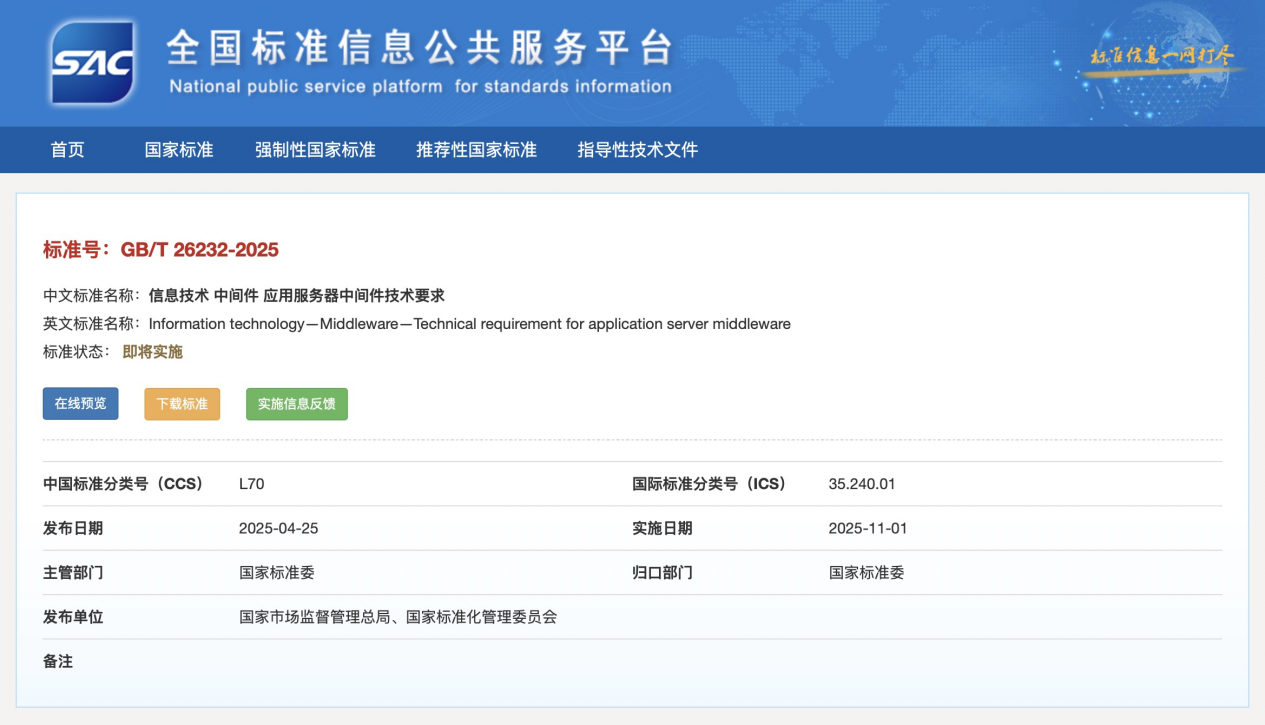
"Information Technology — Middleware — Technical Requirements for Application Server Middleware"
Application server middleware is middleware software that provides a runtime environment for applications developed in the Java programming language. Its role for Java software is analogous to the way an operating system provides a fundamental runtime environment for applications. As the operational hub of enterprise-level business systems, application server middleware—through efficient resource scheduling and full-link service management and control—supports government cloud services for millions of concurrent users, 24/7 uninterrupted operation of core financial systems, and millisecond-level responses to massive real-time data in the energy industry, providing a stable, secure, and scalable technical foundation for scenarios such as digital government, smart healthcare, and high-end equipment manufacturing. GB/T 26232-2025, "Information Technology — Middleware — Technical Requirements for Application Server Middleware," specifies requirements for the basic services and application support of application server middleware in terms of functionality, performance, reliability, maintainability, usability, and security. It provides a unified benchmark for product development, system integration, and quality evaluation, and is of great significance for improving the stability of enterprise-level applications and promoting digital transformation.
"Information Technology — Middleware — Technical Requirements for Message-Oriented Middleware"
Message-oriented middleware is used to transmit messages between different applications, systems, or components, enabling decoupling and asynchronous communication in distributed systems. With its highly reliable asynchronous communication capabilities, message-oriented middleware connects real-time data interaction links across platforms and systems, supporting millions of highly reliable transaction clearings per second in the financial industry and guaranteeing cross-departmental collaborative communication on integrated government platforms, thereby strengthening the business continuity defense line in strategic areas such as smart cities and intelligent manufacturing. GB/T 28168-2025, "Information Technology — Middleware — Technical Requirements for Message-Oriented Middleware," specifies requirements for message-oriented middleware in terms of basic functions, reliability, security management, and usability. It provides an authoritative basis for the iterative upgrading of message-oriented middleware products, cross-platform collaboration, and quality assessment, and is of great significance for improving the reliability of distributed systems and safeguarding the continuity of critical business.
The message-oriented middleware and application server middleware covered by these two newly released national standards are widely applied across industries and have deeply integrated into the core scenarios of key sectors, becoming critical software infrastructure that ensures efficient business operations. The release and implementation of the standards will safeguard the large-scale application of middleware in fields vital to the national economy, such as finance, government, energy, and transportation, and help the digital transformation goals of key industries under the 14th Five-Year Plan land efficiently.
As the two most representative and widely used categories of foundational middleware, application servers and message middleware are areas where Apusic has deep product development expertise. Since its debut in 1999, the Kingdee Apusic Application Server (AAS) has been hailed by the industry as "national software reaching for core technology"; the Kingdee Apusic message middleware AMQ and its successor, the distributed message queue ADMQ, have been applied at "financial-grade standards" in the critical information systems of customers across numerous industries. The pursuit of product excellence knows no end—Apusic's path of product innovation and development continues to extend into the distance, in step with the building of Digital China!
Latest News
Driving Innovation and Development in China's Foundational Software Industry

Driving innovation and development in China's foundational software industry

High-Quality Development: Interim Results Review