
"The Journey and Original Aspiration of Kingdee": Apusic's Dedication and Perseverance
Driving the Innovation and Development of China's Foundational Software Industry
"The Journey and Original Aspiration of Kingdee" recounts a chapter of Apusic's innovation history, resonating deeply with many Apusic colleagues, who eagerly shared the article. Today, Apusic still counts among its ranks several R&D veterans who have served for more than 20 years and participated in the early days of the "Kingdee Central Research Institute." They deeply identify with Apusic's culture of independent innovation and take pride in their dedication to and perseverance in foundational technologies.
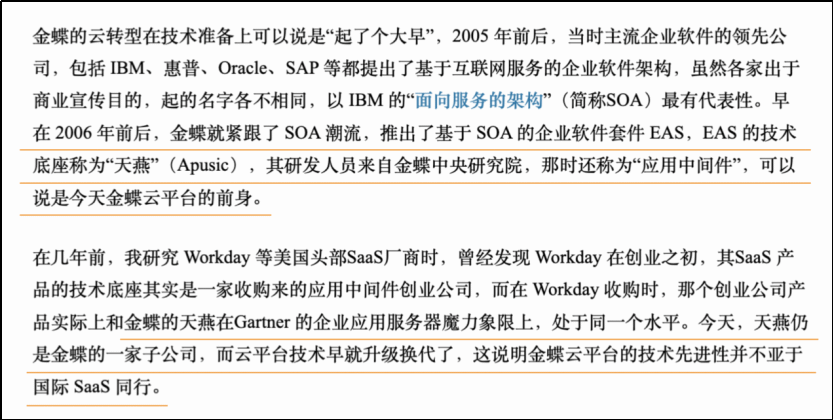
Recently, Mr. George Chen Guo published an article titled "The Journey and Original Aspiration of Kingdee" on his WeChat official account (GEORGE Chen Guo). Discussing the early technical preparations for Kingdee's cloud transformation, he noted: "As early as around 2006, Kingdee closely followed the SOA trend and launched EAS, an SOA-based enterprise software suite. EAS's technical foundation was called 'Tianyan' (Apusic), and its R&D staff came from the Kingdee Central Research Institute. Back then it was still called 'application middleware'—arguably the predecessor of today's Kingdee Cloud platform."
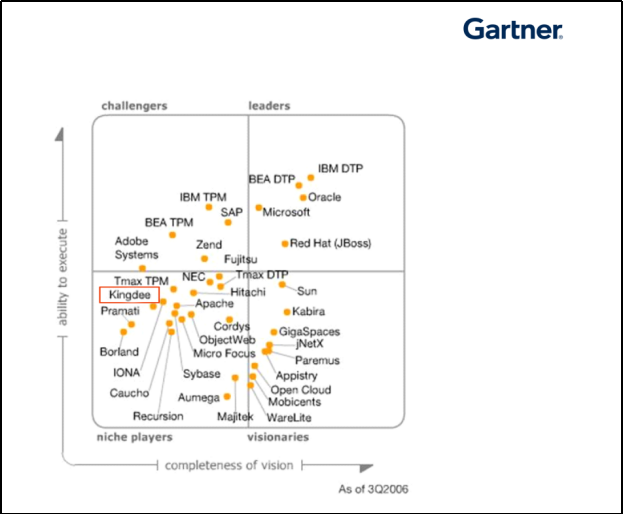
Kingdee's exploration in the SOA field, and the story of how Kingdee Apusic middleware was selected for the Gartner Magic Quadrant for application servers as early as 2006, are recorded in considerable detail in the book "Solid as the Great Wall, Wise Beyond the World: 20 Years of Mission and Responsibility," published on Apusic's 20th anniversary. The following is an excerpt from the book.
Kingdee Middleware Selected: China Achieves a Major Breakthrough in SOA
In the second quarter of 2007, Gartner released a global application infrastructure software report. Notably, the report for the first time provided a detailed analysis of the major software companies offering SOA services and listed 19 leading vendors worldwide capable of delivering next-generation SOA services. Global software giants such as IBM, BEA, Oracle, and Microsoft were all included—and, strikingly for the industry, Kingdee Middleware was also on the list, one of only four Asian software companies to make it, alongside NEC and Tmax, and the only one from China.
Gartner commented in the report: Kingdee Apusic middleware meets all core functional requirements of new SOA applications, providing end business users' business logic with a solid container (the Apusic application server) and an Eclipse-based development platform (Apusic Studio). Moreover, Kingdee focuses on deep partner development capabilities and has a strong presence in Chinese channels, which will play a key role in its continued expansion of influence in the SOA market.
Since Gartner first proposed the SOA concept in 1996, the Kingdee Central Research Institute began following SOA and studying it in combination with Kingdee's years of enterprise application development practice. Through extensive contact with customers, Kingdee sensed their need for flexible business integration through SOA. By organizing and refining SOA theory and drawing on years of user experience, starting from foundational components, Kingdee gradually carved out its own path and formed a comprehensive SOA solution suited to domestic users.
1. Foundational Technology Is the Root
As recorded in the book, the reason Kingdee Middleware entered the ranks of the "19 leading vendors worldwide capable of delivering next-generation SOA services" lies, in Gartner's assessment, in its solid foundational technology support (such as the Apusic application server). The author of this account also repeatedly emphasizes the importance of foundational technology support. In his view: "Without foundational technology support, no architectural theory, however advanced, can take root."
Facing a situation in which underlying foundational software was entirely monopolized by foreign vendors, Kingdee persisted in independent R&D and innovation, devoting itself fully to building foundational software with proprietary intellectual property. The underlying architecture of the Apusic SOA solution is based on the Kingdee Apusic application server and Apusic message middleware, and includes components such as a portal, an enterprise service bus (ESB), integration components, and development tools. These out-of-the-box foundational products cover most enterprise SOA scenarios, enabling business standardization and decoupling, greatly reducing implementation difficulty, cutting users' technical investment during implementation, and lowering procurement costs.
The successful development of this foundational software, in turn, provided better support for the implementation of Kingdee's SOA theory, freeing Kingdee's SOA solutions from the constraints of foreign software and enabling them to better adapt to and serve domestic users. By combining theory, business, and technology, Kingdee improved step by step in practice, persisted in independent R&D, continuously refined its products, and perfected its SOA solutions—advancing steadily and building up strength for a breakthrough—ultimately achieving results that drew the attention of the entire industry.
2. Apusic's Dedication and Perseverance
In the 1990s, homegrown foundational software in China was essentially a blank slate. The middleware market was monopolized by the two international giants IBM and Oracle, which had entered China early and, leveraging strong brand influence, deep technical accumulation in IT, and well-matched support in areas such as databases and servers, had already built an enormous domestic user base and occupied a leading market position.
Kingdee Middleware (the predecessor of Apusic) was born in just such a market environment. In 1999, it wrote the first line of Java code for domestic middleware and formally marched into the foundational software field; in 2000, the middleware company was established and released China's first Java middleware product—the Apusic Application Server (AAS). In that era, investing in foundational software was extremely difficult. Lacking both talent and market, a company that wanted to gain a foothold in foundational software had to master core technologies and develop truly solid products before it could hope to compete with foreign vendors.
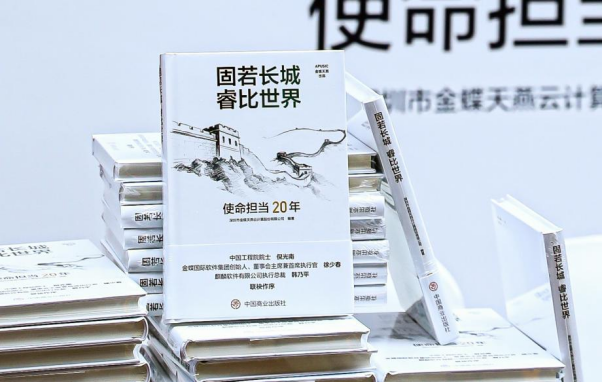
"Solid as the Great Wall, Wise Beyond the World: 20 Years of Mission and Responsibility"
Published by China Commercial Publishing House, with a preface by Academician Ni Guangnan
A comprehensive showcase of Apusic's 20-year growth journey
And, from one cross-section, a portrait of the independent innovation path of China's homegrown foundational software
Kingdee Middleware's cultivation of independent foundational software R&D beginning in 1999 blossomed in the SOA exploration and practice of the first decade of the new century. This allowed Kingdee Middleware to find a development path—relying on "foundational technology and independent R&D"—and to form a conscious commitment: dedication to and perseverance in the foundational software industry.
Then came 2013, when the "Prismgate" incident shook the world. Internationally, "infiltration, espionage, and control" in cyberspace grew increasingly intense. Meanwhile, as informatization deepened across the board, national economic and social development became ever more dependent on information network systems. It was in this context that the famous "April 19 Speech" was delivered in 2016. General Secretary Xi Jinping clearly pointed out that core internet technologies are our greatest "lifeline," and that being constrained by others in core technologies is our greatest hidden danger. Core technologies can be grasped from three aspects: first, foundational and general-purpose technologies; second, asymmetric and "trump card" technologies; and third, frontier and disruptive technologies. The combination of these three aspects forms a perfect balance, ensuring both medium- and long-term development and present-day security and stability.
Middleware, together with operating systems and databases, forms the "troika" of foundational software and, like chips, belongs to national critical information infrastructure and falls within the scope of foundational technology. Against the backdrop of safeguarding national cybersecurity in this era, the crystallization of middleware technology lies in autonomous, secure, and reliable middleware products.
So, having come this far, if asked what lies at the core of Apusic's dedication and perseverance, the answer is: product competitiveness. Apusic President Chen Qifa puts it this way: "Without products—without good products, without competitive products—this company would cease to exist, let alone create value for customers or shoulder its mission for the nation."
3. The AI Era: Upholding Fundamentals While Innovating
The development of AI technology—especially the sudden debut of ChatGPT—seems to have ushered us into the AI era overnight. Data shows that in 2023, the enterprise adoption rate of generative AI in China had reached 15%, with a market size of approximately RMB 14.4 trillion (CCID). Experts also predict that by 2035, generative AI is expected to contribute nearly RMB 90 trillion in economic value globally.
Major countries and regions around the world are equally ambitious. The United States provides legal safeguards and financial support for AI R&D and application through legislation and dedicated agencies; the European Union, Japan, and South Korea have rolled out policies encouraging enterprises to increase R&D investment, cultivate AI talent, and advance AI innovation and application; and China has designated AI as a national strategic emerging industry, promoting the development of the AI industry through policy support and funding.
One often hears the refrain, "Every industry is worth redoing with artificial intelligence." Amid such an intense atmosphere of technological and social transformation, where should a foundational software company go? The answer, in fact, lies in the road already traveled.
Looking to the future, we return to the essence of business: meeting market demand and creating value for customers. The underlying logic of the foundational software industry remains core technologies, the products crystallized from them, and the fulfillment of customer value. Upholding fundamentals, therefore, means grasping customer value and the value of technology and products. On this foundation, we can talk about embracing innovation and embracing the AI era.
Recently, at an industry conference hosted by the China Academy of Information and Communications Technology (CAICT), Apusic unveiled a "new type" of middleware—the AI application suite ASK (Apusic AI StartKit)—which internally is regarded as an embodiment of the philosophy of "upholding fundamentals while innovating."
What customers think of is what we urgently act on. This is the essence of business—everything hinges on customer value. Against the backdrop of AI superimposed on digital transformation, the difficulties B-end customers face in landing large model applications are exactly what ASK targets, and the very origin of Apusic's investment in innovation. We believe such product innovations will keep emerging in the future.
Conclusion
"The Journey and Original Aspiration of Kingdee" tells the story of Kingdee's magnificent journey—the past: cloud transformation; the present: the large-enterprise market; the future: the road of AI—while its original aspiration is "to let Chinese management models rise globally." Apusic's dedication and perseverance likewise rest on an unwavering original aspiration and mission: driving the innovation and development of China's foundational software industry.
Latest News
Driving Innovation and Development in China's Foundational Software Industry

Driving innovation and development in China's foundational software industry

High-Quality Development: Interim Results Review